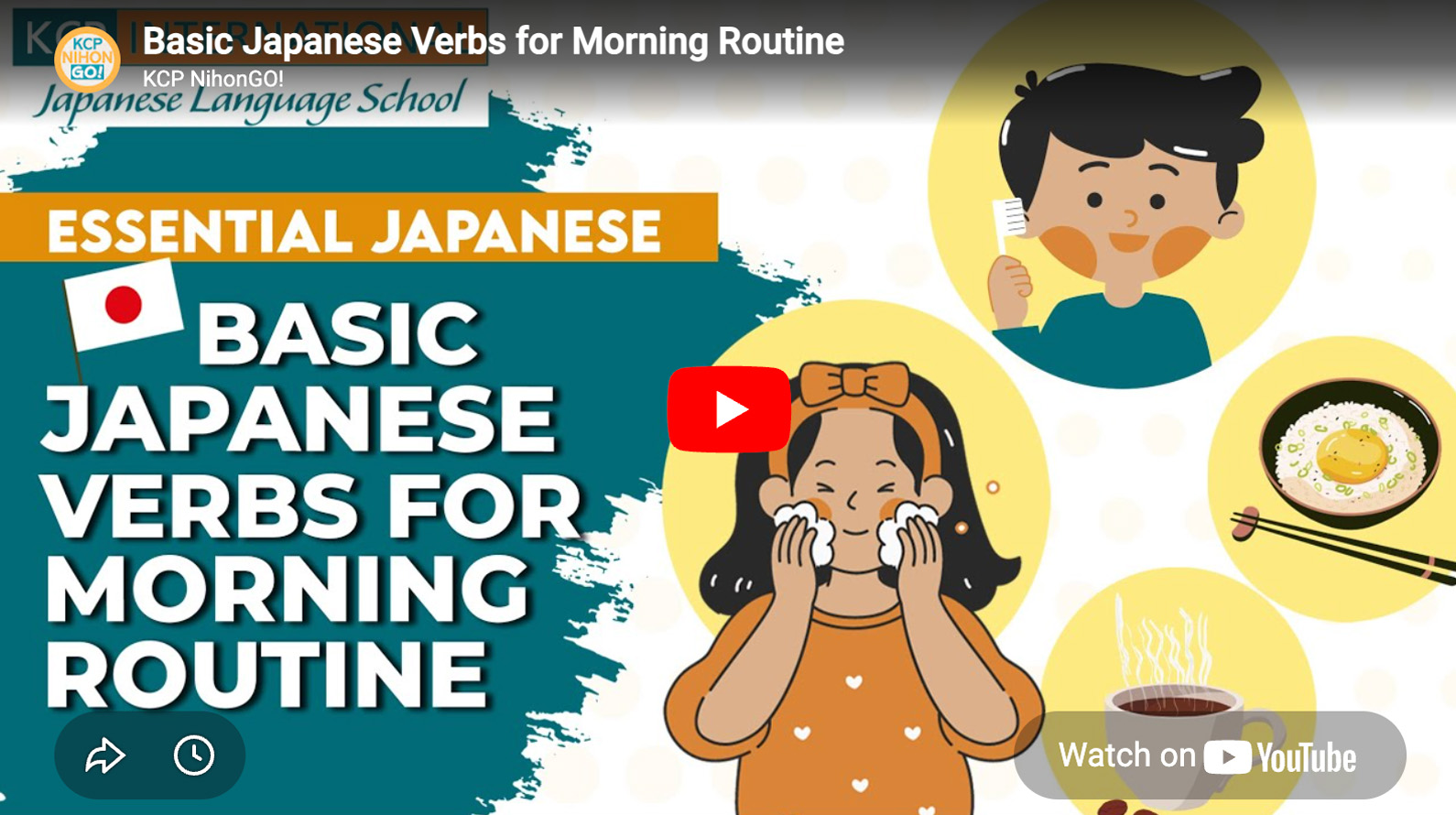
The hardest part of learning a new language is often talking about the stuff you do every day. Like, how do you even say, “I brush my teeth” or “I chugged coffee” in Japanese? 😅
If you can describe your morning routine, you’ve unlocked a ton of basic conversation power! This lesson is all about the must-know Japanese verbs that take you from 起きる (okiru, “to wake up”) to 行ってきます (ittekimasu, the phrase you say when you leave home for the day).
The Morning Routine Vocabulary List
Here are 11 essential verbs you need to describe your start to the day. Pro-tip: Focus on the dictionary form (the one ending in u) first, then check out the polite -ます (-masu) form!
| Japanese | Romaji | English | Notes |
| 起きる | okiru | To wake up | This is an Ichidan (ru-verb). |
| 顔を洗う | kao o arau | To wash one’s face | 顔 (kao) means “face.” 洗う (arau) is “to wash.” |
| 歯を磨く | ha o migaku | To brush one’s teeth | 歯 (ha) is “tooth/teeth.” 磨く (migaku) is “to polish/brush.” |
| シャワーを浴びる | shawaa o abiru | To take a shower | This uses the borrowed word シャワー (shawaa). |
| トイレに行く | toire ni iku | To go to the toilet | トイレ (toire) is the loanword for “toilet/bathroom.” |
| 服を着る | fuku o kiru | To wear clothes/put on clothes | 服 (fuku) means “clothes.” |
| 化粧をする | keshō o suru | To put on makeup | する (suru) is the verb “to do,” often used with nouns for action. |
| 髭を剃る | hige o soru | To shave one’s beard | 髭 (hige) means “beard/mustache.” |
| 食べる | taberu | To eat | 朝ご飯 (asagohan) or 朝食 (choushoku) can be used to say “I eat breakfast.” Choushoku is slightly more formal and is often used in writing or on menus. |
| 飲む | nomu | To drink | Use the object + particle を (o) before 飲む (nomu) (e.g., koohii o nomu). If you just say 飲む (nomu), it often implies drinking alcohol! |
| 行ってきます | ittekimasu | I’m leaving now (and will come back) |
A set phrase. Used when leaving home or the office.
The standard response to 行ってきます (ittekimasu) is いってらっしゃい (itterasshai), which literally means “please go and come back.” |
Practice with Sample Sentences
Let’s see these verbs in action. Using the polite -ます form is always a safe bet for general conversation!
1. 起きる (okiru)
- 今朝 7 時に 起き まし た。
kesa shichi-ji ni okimashita.
I woke up at 7 o’clock this morning. - 毎日 6 時に 起き ます。
mainichi roku-ji ni okimasu.
I wake up at 6 o’clock every day.
2. 顔を洗う (kao o arau)
- 水で 顔を洗い ます。
mizu de kao o araimasu.
I wash my face with water. - 朝は 顔を洗い ます。
asa wa kao o araimasu.
I wash my face in the morning.
3. 歯を磨く (ha o migaku)
- 歯を磨き ます。
ha o migakimasu.
I brush my teeth. - ご飯の 後 に 歯を磨き ます。
gohan no ato ni ha o migakimasu.
I brush my teeth after eating.
4. シャワーを浴びる (shawaa o abiru)
- 熱い シャワーを浴び ます。
atsui shawaa o abimasu.
I take a hot shower. - 私 は 朝 シャワーを浴び ない。
watashi wa asa shawaa o abinai.
I don’t take a shower in the morning. (Casual)
5. 化粧をする (keshō o suru)
- 化粧を し ます。
keshou o shimasu.
I put on makeup. - 私 の 友達 は 毎日 化粧をしない。
watashi no tomodachi wa mainichi keshou o shinai.
My friend doesn’t put on makeup every day. (Casual)
Quick Tip: Sequencing Your Routine with 「まず」「次に」「それから」
To sound natural when listing actions, use these simple sequence starters!
| Japanese | Romaji | English |
| まず | mazu | First / To begin with |
| 次に | tsugini | Next |
| それから | sorekara | And then / After that |
Example Sequence:
- まず、顔を洗い ます。
mazu, kao o araimasu.
First, I wash my face. - 次に、歯を磨き ます。
tsugini, ha o migakimasu.
Next, I brush my teeth. - それから、コーヒーを飲み ます。
sorekara, kōhī o nomimasu.
And then, I drink coffee.
Time to Test! (Interactive Quiz)
Ready to see how much you remember? Choose the best answer for each question!
Conclusion & Next Steps
That’s a wrap on your Japanese morning! See? You already know how to describe a huge part of your day using super practical verbs. Keep practicing the -ます forms—they’re your best friends for sounding polite and clear.